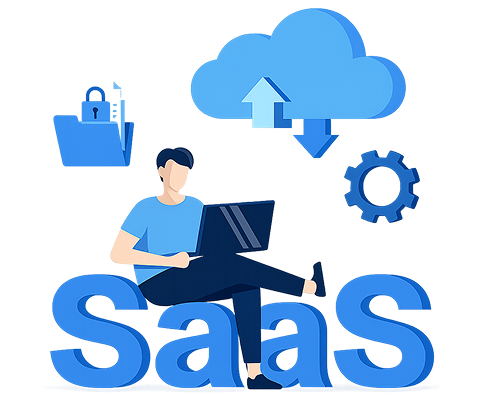
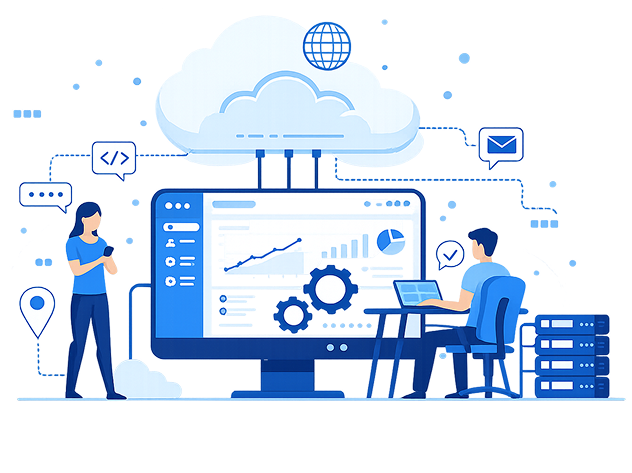

SaaS software development includes creating web-based software that people can use on the web, without downloading any software. They allow the flexible use of resources, centralized data management, and scalable operations, making them fit for different types of companies, from startups and growing businesses to larger companies.
Moreover, a subscription-based approach will assist companies in decreasing initial costs for technological solutions while increasing their capacity according to requirements. SaaS software can be integrated with other technologies, automate tasks, and promote more efficient collaboration among teams without the necessity to invest heavily in the infrastructure of the organization.
With SaaS development, companies are able to create platforms that are secure and highly performant, as well as provide easy-to-use interfaces with advanced integration features. From CRMs and ERPs to project management solutions and eCommerce software, SaaS applications allow improving the workflow of companies with scalable cloud technology.Â
California, especially the Silicon Valley region, has an extensive network of technology companies and startups. This ecosystem fosters innovation and provides access to the latest advancements in software development and cloud computing.
With prestigious universities and research centers in California, there is a constant influx of highly skilled tech talent. These developers are not only proficient in the latest SaaS technologies but also stay updated on industry trends, helping you stay competitive.
With California’s rigorous data privacy and cybersecurity regulations, local SaaS developers are well-versed in compliance standards, including CCPA and GDPR. This knowledge ensures that your SaaS application is secure and meets all regulatory requirements, which is crucial in today’s data-sensitive business environment.
Developing customized SaaS solutions that are in sync with your business goals.
Creating intuitive and user-centered interfaces that enhance user engagement and satisfaction.
Secure, HIPAA-compliant SaaS solutions for managing patient data, scheduling, and telehealth services.
Platforms for secure transactions, compliance tracking, and data analysis, crucial for banks and financial institutions.
SaaS applications that streamline inventory management, sales tracking, and customer service.

Learning management systems (LMS) and virtual classrooms that enable remote learning and course management.

The choice of a suitable partner may greatly affect the performance and further success of the SaaS product you want to create. Before embarking on a new project, companies should assess the developer's expertise, technical abilities, communication skills, and readiness to assist with the future development of the product.
Answers to common questions about our services, process, and digital solutions.
It means developing cloud software that can be accessed by users via the internet. Such software may work in the subscription mode, serve different users and companies, and have centralized updates and data management.
Costs will depend on the product’s functions, complexity, integrations, and architecture, user needs, and technical characteristics. Development of an MVP is cheaper than the creation of a full-fledged SaaS platform with automation, analytics, billing, enterprise-level, and other features.
Time spent will vary according to the product’s complexity and features. For example, the creation of an MVP requires several months. But the development of an advanced SaaS solution with complex integrations, various user roles, and more features will require more time.
Certainly. Our specialists will be happy to help you create a functional SaaS MVP with key features necessary for testing the product, receiving user feedback, and proving its potential on the market.
To make the SaaS application scalable, we will use a flexible architecture, cloud infrastructure, an efficient database, and a scalable backend. It will allow your platform to cope with an increasing number of users, data volume, and new features.
Yes. Integration of the SaaS platform with any third-party application will be possible using APIs and other integration methods. Popular integrations include payment gateways, CRMs, analytics platforms, communication tools, cloud services, and various business solutions.
Security measures for your SaaS platform can include secure authentication, an access control system, encryption of data, API security, software updates, protection of cloud infrastructure, and others.
Yes. We will provide you with ongoing support services such as bug fixing, performance monitoring, security updates, infrastructure management, feature improvements, and technical upgrades.